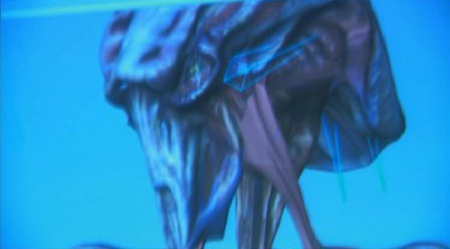
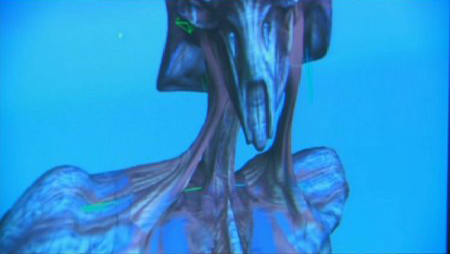
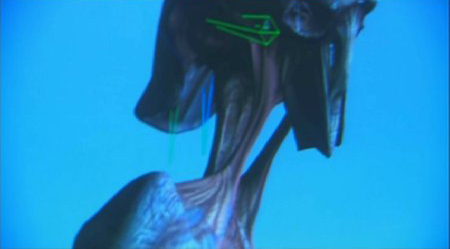
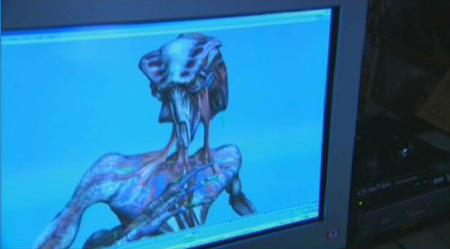
Designing Species 8472
Concept artist Steve Burg had to design the first non-humanoid alien of Star Trek. Species 8472, which would first appear in “Scorpion”, was a departure from any race seen yet.
It would also be the first fully computer-generated species of Star Trek.
Although the technology was still far from perfect, according to VFX supervisor Ronald B. Moore, it was good enough for Voyager’s needs.
“We’d suggested it before,” but the producers were reluctant. “With CGI you’re always on the cusp. We’re not really good at people yet. Jurassic Park was showing us that we could do things as long as they weren’t too real.”
The seeds had been sown in the Season 3 episode “Macrocosm”, which featured giant microbe-like creatures that were completely computer-generated.
The producers had been impressed by what they saw and wished to take the technology further. So when they came up with an alien race that was destroying the Borg, they were ready to experiment with a CG alien.
Three legs
Determined to take full advantage of this technology, VFX producer Dan Curry suggested that, if it was going to look really alien, the creature should have three legs.
“We had a script for a vicious alien creature that had to be so powerful and so fearsome that it was able to chop up and destroy the Borg,” he recalled.
When we got the story, I was interested in creatures that had weird locomotive properties. I guess it goes back to the old fifties sci-fi book The Day of the Triffids, about these tripod plants that come to Earth and cause trouble.
Curry did some crude sketches and worked with John Teska and Steve Burg, swapping drawings back and forth until they came up with the 8472.
Curry’s proposal, however, was not immediately passed on to Foundation Imaging, the company which would make the CGI. Ron Moore explained that this was because he did not want to impose a design on the people he works with too early in the process:
We approached Ron Thornton at Foundation and said, “Look, here’s what we’re trying to do. Why don’t you have your guys draw something up and we’ll look it over.” The way I like to work with the CG houses is to be nebulous. I don’t like to be real specific, because it ties their hands in.
So, with plenty of room for latitude, Foundation Imaging turned to Burg, a veteran of films such as The Abyss and Contact, and of several earlier Foundation Imaging projects, including Hypernauts. Steve had designed the three-legged Gloose that had stuck in Curry’s mind. Burg worked with Thornton, Foundation Imaging’s owner, who passed all of Curry’s and Moore’s comments onto him.
Big and ferocious
“The main desire,” said Burg, “was to do a creature that was definitely not a man in a suit, just to see how that would work out. They were still writing the script at that moment, so there was only a very brief description.”
It said it was big and ferocious and terrifying and moved very quickly; it was 14 feet tall at one point. That was about it. There aren’t really that many limitations on what you can accomplish. It’s mostly about artistic choices. You don’t have to think about physical limitations like with a puppet creature. I would say creatures and robots are very much like character design for animation. You just have to try to evoke a certain feel and create an overall impression.
Burg’s initial drawings, however, did not particularly impress the producers. “They thought that it was too human-like,” he said, “and too similar to the creature from Alien.”
I think it was the head they were most concerned about. They wanted something like the alien, but they didn’t want a ripoff. They wanted something that was that distinct; something very nasty and powerful. It also had to be intelligent. The thing about an alien, unfortunately, is making it smart usually means making it something we can relate to on a human level. Probably, real aliens would be so weird that they’d be unfathomable. But this is film and television; we have to be able to understand it fairly quickly.
Once the first drawing had been rejected, Thornton told Burg he should produce some quick sketches showing a variety of looks they could choose from.
The next batch were just basic silhouettes. Some have three legs; some have two legs; some of them have a split, tripodal base, with below the knee bifurcated. I don’t think I had any real strong idea. In that situation you basically try to do as many variations as you can and hope that one of them will click.
The series of drawings included several three-legged creatures that were close to what Curry was looking for. The producers chose one of these drawings and asked Burg to develop it further. This involved a fair amount of work, since the view they had chosen showed the creature from behind and not its face.
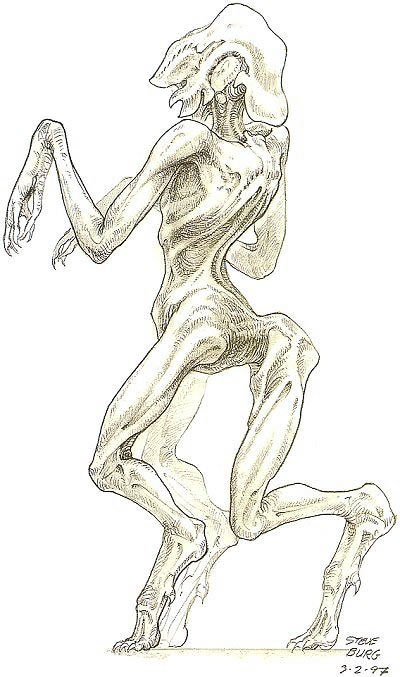
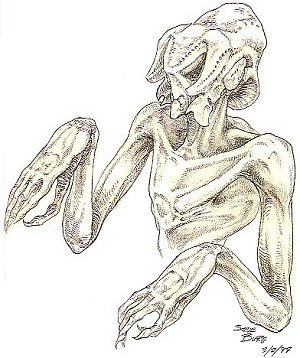
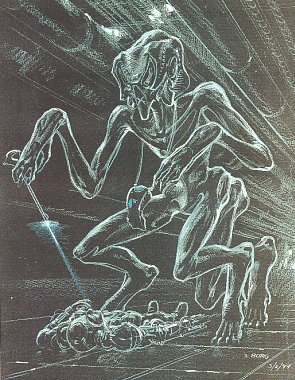
Burg concentrated on the creature’s body. As he confronted the difficulties of its alien anatomy, it started to take on a more definite form.
With CG, even if things don’t have to support their own weight, you still have to think about how it will move in a general sense. The biggest problem was dealing with that third leg. In the end it became like a human leg, but it started out as more of a symmetrical tripod; all the legs pointed out from the middle and the body was more centrally located. A tripod is one of those things that sounds great, but if you have a tripod, and the creature still has a front and back, what do you do? I think it moved back toward something you could relate to; it became sort of a centaur.
By this stage, Burg was starting to develop a clear idea of what Species 8472 would look like, even if the final design was still forming with each successive drawing.
The thing about any of these things, it’s not like it’s any one moment the design suddenly appears. It’s more of a process that evolves. There are various people who affect it. Your job is to try to capture the quality that people are looking for in a visual. I think that once this guy got underway, he began to take on his own identity. It’s really good when that happens. It’s almost like these things come out of a fog. It’s a gradual thing, but by the end it becomes its unique self.
Creating the CG
The task of creating the CG version of the Species 8472 was given to John Teska at Foundation Imaging.
By the time Teska became involved, Burg had already produced a set of drawings that showed what the creature should look like, but a lot of creative work remained to be done.
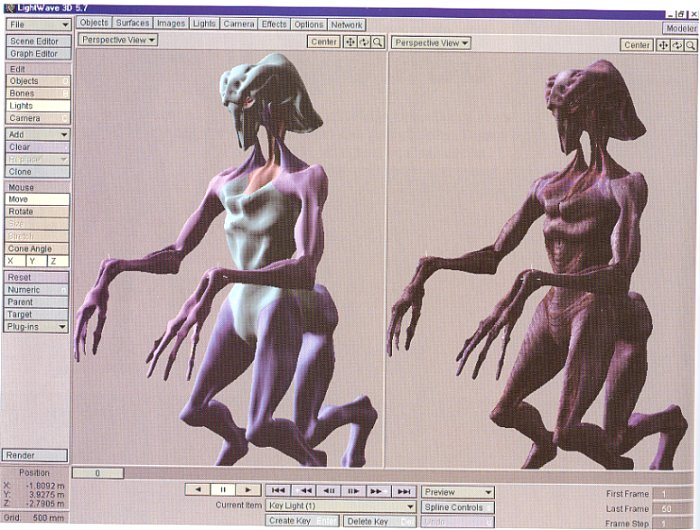
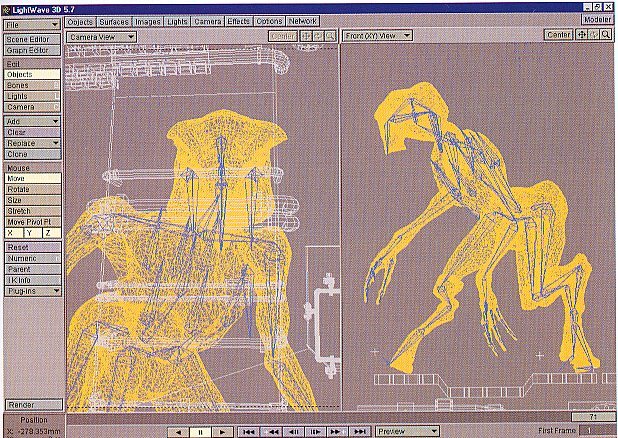
In fact, the producers handed him several drawings with instructions to use different elements from each one. These gave Teska an idea of what they wanted, but there was room for interpretation. The finished model turned out similar, but not quite identical, to Burg’s final concept drawings.
“It was something of a Frankenstein’s monster,” said Teska.
The key features, the things that distinguished the creature, were the three legs, the tendons in the neck and the basic head shape, all of which had been laid out in Steve’s artwork.”
I followed that fairly closely. But, in addition to pulling these designs together, I had to go in and do deeper detail like sorting out the colors and working out literally what the flesh would look like — the wrinkles and things like that. Certainly, there was plenty of room to put my own ideas in and breathe life into it.